
Helping Builders
Building is messy; tolerate uncertainty in pursuit of growth

Steve Ballmer once told my Stanford class, “Business is about ideas and people.” Ideas need people who are builders and managers. Builders must come first. I worked with a few great builders at GE ... David Joyce (aviation), Omar Ishrak (healthcare), Joe Mastrangelo (energy), Gary Wendt/Dennis Nayden (Capital), and Bonnie Hammer (media).
Today, it is harder than ever to be a builder inside a public company. CEOs are getting fired at a record clip; one in nine is new this year. Activists rule. PE has raised record funds, despite average returns. What are the chances that legacy boards are saying, “We should invest more”? Not great. I admire and lament: SpaceX and Anduril and Palantir are great companies in the industrial world. Probably 10-15 legacy players could have competed in the same markets. None of us have taken the risk.
Building = Risk + Culture
When I moved to the Valley, I knew that start-up entrepreneurs would fascinate me. I have been even more impressed by “Big Tech” companies like Amazon, Apple, Microsoft, and NVIDIA. They always play offense with a culture of reinvention. I think this is just instilled in their DNA. When you see product investors get rewarded, you become an innovator. When you see cost cutters get rewarded, you become a cost cutter.
These companies innovate and execute at scale. They have cultures where everyone serves the product, operators and innovators alike. An executive at Apple will talk about products and customers, not process and functions. A committed builder will become a great operator. The inverse, however, isn’t necessarily true. If you think of yourself as a manager – a generalist – you will become consumed by process. Builders view process as a way to fund what is next.
As companies grow, they either create an “upward spiral” or a “downward spiral.” A culture of reinvention that wins in the marketplace attracts great talent; great talent, in turn, keeps pushing to win in the marketplace. You create an internal network effect. But the inverse is also true. When you don’t build on market leadership, the best people stop coming. Markets are dynamic and tough; you can’t lose the shine!
There is an important difference between a “culture of learning” and a “culture of reinvention.” Lots of companies promote continuous improvement and that is a very good thing. Reinvention is improvement plus investment. VC-backed companies account for 94% of R&D spend across U.S. public companies. Capital speaks louder than words.
Why could legacy companies get left behind? It requires an appetite for risk. GE Aviation won because it took big financial swings when it was inconvenient. The team was amazing and I helped. But I also made a few mistakes, sometimes not pressing hard enough to bring in the talent who could build the future. I once passed over Omar Ishrak (Medtronic CEO and Ph.D.) to run Healthcare in favor of a more conventional finance leader. So, the issue is not talent. GE has thousands of talented engineers, ops managers and salespeople who can compete with any team from Amazon or Apple. Leaders should push harder for growth.
Fortunately, the right culture can attract builders and managers. In the start-up world, I have seen the power of blending founders with experienced players as companies scale. The right legacy talent brings pattern recognition and a sense for mutual accountability in teams. They don’t panic in a crisis. They value the passion and insight from a founder; they use process to win in the market, not play it safe. Khozema Shipchandler is the excellent CEO of Twilio, an AI/Software company. He also has deep legacy roots. He is a builder; builders can come from anywhere.
From Founder to CEO
I have had the chance to work with a number of great founders. Some are just entrepreneurs, like Jonathan Bush of Athena Health or Mihir Shukla of Automation Anywhere or Chris Turlica of MaintainX or David Rogier of MasterClass. Others are deep technologists, like Gene Berdichevsky of Sila Nano. A few are experienced operators, like Rich Whitney of Radiology Partners or Hayes Barnard of GoodLeap. Many are humble in their success, like Michelle Zatlyn of CloudFlare.
Who wants to go all the way? Some founders have the desire to lead at scale, but not all. There is nothing more heart-wrenching than seeing a founder fail while the company succeeds. There is nothing more satisfying than watching a founder mature and grow. They can change the world. KR Sridhar ... the founder and CEO of Bloom ... offers a pretty good window on how a talented leader grows into a CEO. This is what I learned from watching KR:
Continue to learn. Some founders make a little money and start thinking they know it all. KR is never satisfied; he is always searching for the next idea. He is incredibly discerning ... who are the right teachers and where? He listens, but not to everyone. He is very disciplined ... new lessons only sharpen his focus. The magic words for a founder becoming a CEO ... “help me” and “never satisfied.”
Let the product and market rule. KR sustains a deep vision for innovations that change markets. Look, I heard hundreds of energy pitches at GE and in clean tech venture investing. These include every era and power source. But KR thinks in terms of “First Principles” for the industry. What is the system? The economics? The impact? The scale? In 40 years of energy investing, I had rarely seen this depth.
“Can’t” is not accepted. Bloom commercialized fuel cells, something no one else could do. This required pushing the boundaries of material science, ultimately leading KR to mine dirt in Montana and run a processing plant there. Is this in your DNA? If not, you can’t build.
Don’t become a “manager” too early: seek to control everything, everywhere ... all the time. Professional managers have been trained not to micro-manage. KR is relentless. The builder and team do their work together. Micromanaging with a builder is not a burden. He is a teacher; the team is learning together.
Recruit people who make you uncomfortable. KR had TJ Rodgers, an early era semiconductor founder, on his board for 10+ years. TJ has a “brutal user interface,” but is a manufacturing savant. It worked ... the company owns a flexible and resilient supply chain, rare in the energy industry. For a founder to become a CEO, they must realize that talented outsiders add leadership capacity.
Maintain high standards for people even as you grow. We have churned multiple C-suite leaders since I have been on the board. Most investors preach the continuity and safety that recruiting domain experts can bring. Ultimately, builders need athletes with massive intellectual and physical capacity. A good builder recruits for how fast people can learn, not what they know. A founder doesn’t know good until they see it. Once KR sees “good” he wants more.
As you travel from founder to CEO, you can still be an optimist. Fred Smith, CEO of FedEx, was my friend; he was one of the great founders who became a CEO .... he was always an optimist. Builders have to say, “here is what can go right.” Frequently, a board will say ... “don’t be so optimistic, what can go wrong?” But to KR, realism is creating a different future. He just looks at failure differently. Sure, missing a quarter is bad; but missing a wave is worse. One you find the wave, you blow the quarters away!
Stay flexible ... building takes time. I used to say that founders need resilience. But they never think of quitting. Rather, they pivot for the next attack. It is easy to use Mike Tyson’s quote when discussing builders: “Everyone has a strategy till they get punched in the nose.” But KR is more like Muhammed Ali’s “rope a dope.” He keeps his eyes open while getting punched, looking for his knockout.
Helping Builders
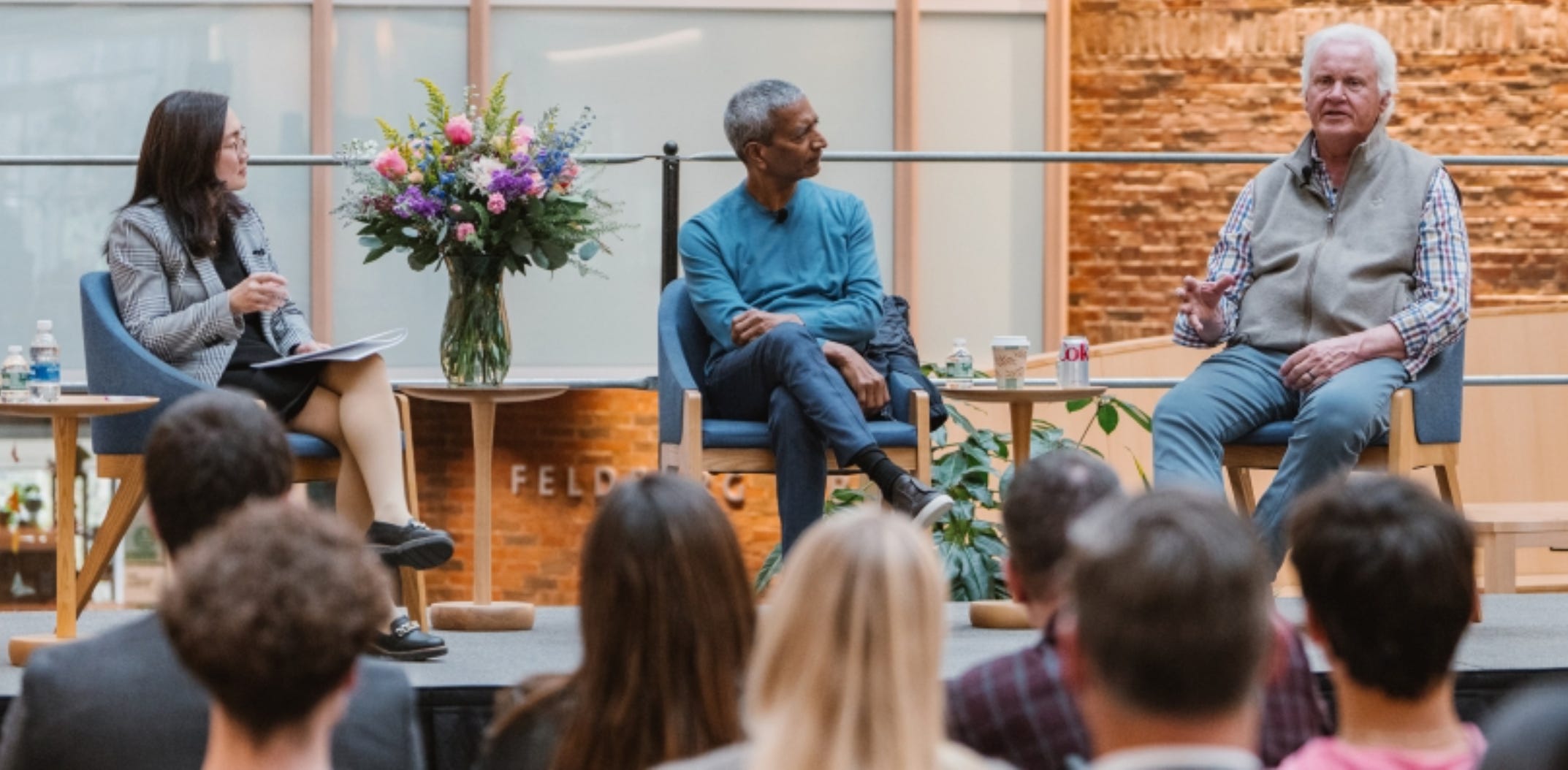
I want to pivot from what I have learned about builders ... to what I have learned about helping them. But first, I want you to consider a concept called “founder mode” authored by Airbnb’s Brian Chesky two years ago:
“In effect there are two different ways to run a company: founder mode and manager mode. Till now most people, even in Silicon Valley, have implicitly assumed that scaling a startup mean switching to manager mode. But we can infer the existence of another mode from the dismay of founders who’ve tried it, and the success of their attempts to escape from it.”
Look, he isn’t entirely right. Leaders who know how to manage can accelerate a company’s growth. In the early days of Amazon, Jeff was extremely skilled at recruiting leaders from companies like Walmart and GE to build capability. But the helper’s main role is to accelerate growth, not “govern progress.” Helpers need to fit the culture, not change it.
Boards Help (Sometimes)
The main way to help founders is by joining boards. I joined the Bloom Energy board in 2018. I enjoy my board colleagues and have learned a lot from them. The thought of having tough-minded leaders around a table, challenging founders and holding them accountable makes sense. We act like a team ... we complement each other ... we care. I never had an aspiration to be on a board. I wanted to be part of the building process, and this is the price of admission.
Now, a word of warning. Governance doesn’t always help companies or investors. It can be a box-checking world directed by lawyers, consultants, auditors, proxy advisors, and activists. The entire process begins to look like a toll booth, not an accelerator. Private equity has a great selling point to management: “join us and we will eliminate all of the nonsense.” Start-ups will only go public once they exhaust capital markets capacity. Sometimes a board can screw up a company not help it. An important trait of a board is self-discipline, not winning an “advisor fashion show.”
What is my role as lead independent director and shareholder at Bloom? I bring the intensity of an operator and the spirit of a helper. I allow KR to leverage my experience in the context of building a generational company. Having been a CEO, I know that sometimes boards sound like an orchestra warming up ... discordant, confusing, and out of tune. My job is to make the board’s great inputs fit a theme and be actionable. I can be credible with the board, saying, “don’t worry; building is messy; let’s tolerate uncertainty in the pursuit of growth.” I am accountable to the company and investors in good days and bad.
TLV Tips:
Have no ego ... none. If you want to be on a board, don’t join one. If you want to serve, you will be awesome. You are an accelerator.
Open your network and make it personal. Help can’t be philosophical or general. Help can only be specific. You need to take the builder with you.
Understand what is different. A helper must remain curious, hearing alternative thinking without prejudice. You can’t only provide old recipes from the past; I have never said, “Let me tell you how we handled this at GE ...” Helping requires finding different ways together.
Make the company smarter, but don’t turn it into storytelling. Know your swim lane. I can’t help an AI or software company build models or write code. But I can tell them, “The CFO is the decision-maker; get there.” Leverage pattern recognition.
Scale the talent, not the reviews. Focus on people first. Make sure to hire good people before installing complicated processes. Many growth companies have people walking from meeting to meeting like zombies. Encourage builders to embrace only the processes that work for them.
Help the builder with “when.” They know what to do. But many builders have never seen cycles. A helper can leverage their experience to differentiate “the urgent” from “the opportunistic.”
Facilitate their push back on time wasting. As companies succeed, more process gets added. Some is good, some is terrible. Listen to the push back. No operator has ever said, “ISS has a good idea...” Help builders keep their eye on the ball.
Be a contrarian. Bloom was an energy start up founded in Silicon Valley. But Silicon Valley has generally been unsuccessful at building energy companies. Not everything is software. A helper should be a contrarian when the group disconnects from the market.
Hold them accountable for the entire basket of work. There are a lot of fun parts to building a company. But the mundane details also matter. Helpers tend to both.
Hold their hand on the worst day. Be a problem solver, not a judge.
This is what a good culture looks like... The CEO says to the board, “You have complete access to the team, without me present. I want you to learn the company and the culture.” The board says to the CEO, “Feel free to push back when we are wasting company time ... you are closer and you care more.” Try it.
We have a lot of work ahead of us at Bloom. Our markets are dynamic ... our customers are demanding ... and our competitors are smart. But, we are all -- in our own way -- builders playing a role to create the future.
It is easy to like KR today. I fell in love with him in February 2019. The company was struggling with the stock at $2/share. Our auditor – in an outrageous move – made us restate previous results based on mistakes they had made. (I guess that is good governance?) KR never blinked. Despite being completely blindsided, he calmly moved the company forward. He was an owner ... a leader ... a builder.
At Bloom, I serve. Let’s keep exploring.
You nailed it with this line: "When you see product investors get rewarded, you become an innovator. When you see cost cutters get rewarded, you become a cost cutter." That is the whole story of corporate cultural drift in one sentence. I can relate to that!
Really appreciated the observations and learnings from KR and your Bloom board experience. So many good lessons and reminders for leaders in those words. Thanks for sharing!
Humility and curiosity are my two favorite traits for friends and coworkers. Apparently ideal for board members as well!